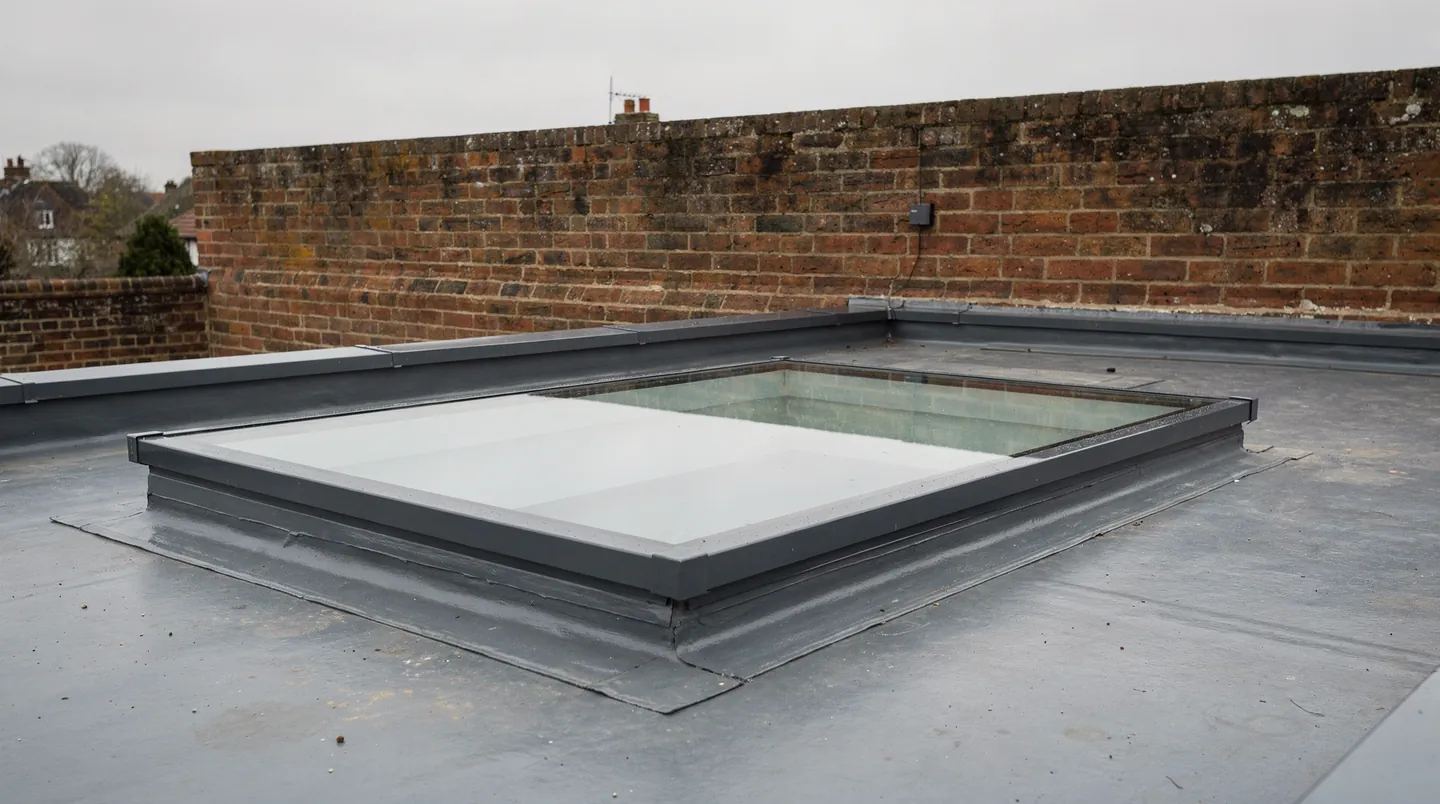
Misted rooflight replacement in SouthamptonClear glass, back on the kerb.

New glass or a whole new unit for rooflights that have clouded between the panes or simply reached the end of their life, measured on the roof, ordered with a named lead time and fitted without disturbing the room below more than it must.

Or call 023 8104 0453

An old rooflight with moisture trapped between its two panes of glass

When a replacement is the sensible step

Cloud between the panes

Once moisture sits inside the sealed unit, no cleaning will reach it, and the unit has to be renewed.

A dated dome or tired frame

An older plastic dome or a worn frame is better swapped for a current unit than glazed again piece by piece.

A flat roof being re-covered

The roofer already has the deck open, which makes it the cheapest moment to renew a rooflight set into it.

What failure looks like, and what replaces it

  • The view from inside a kitchen where a failed rooflight turns the sky grey and blurred
    A grey, blurred view from below
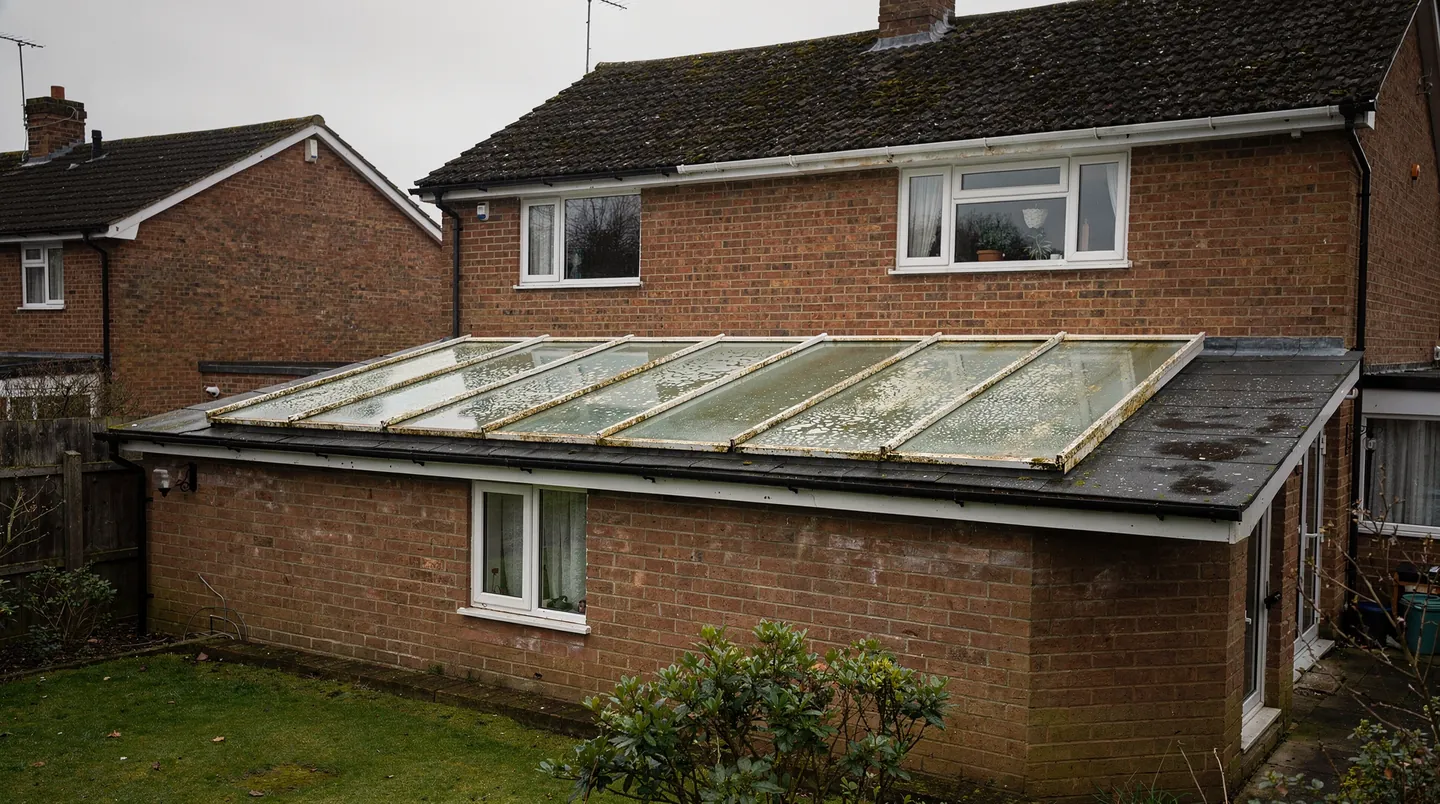
  • An older glazed roof where the sealed units have failed and clouded
    An older glazed roof with clouded units
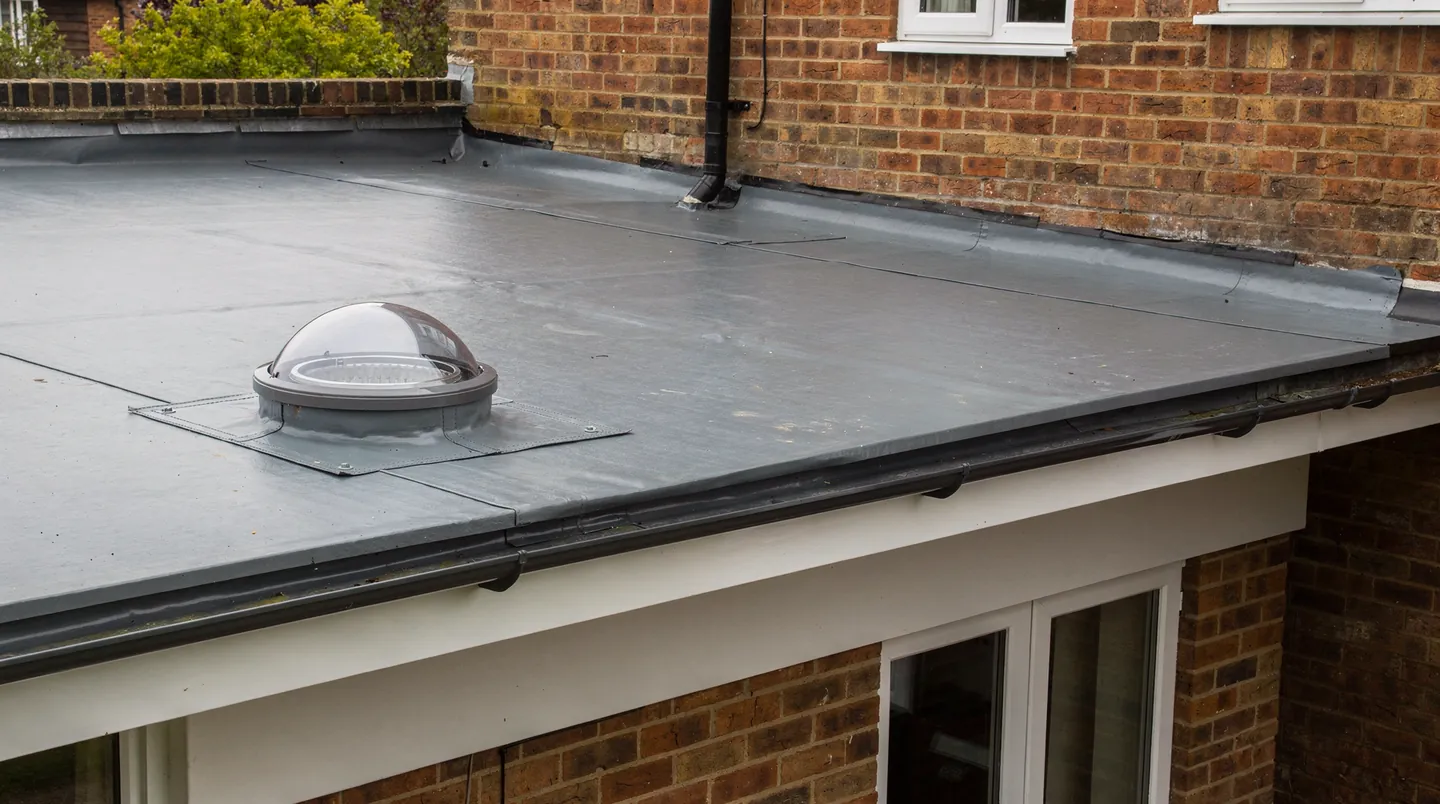
  • A flat rooflight after replacement, with clear glass with a new seal against the kerb
    New glass finished to the kerb

Replacement, step by step

The failed rooflight, renewed with the roof in mind

How to tell what has failed, how far to go in replacing it, and what the work involves on the day

Rooflights do not fail suddenly. They cloud, stain and drop in performance over seasons until the room under them looks dim and tired. This guide is written for owners of a rooflight that has reached that point and for builders asked to deal with one as part of a wider job.

Part 01

When a rooflight fails

Moisture inside the glass, tired frames and domes that have had their time

A sealed rooflight unit is two panes of glass bonded round the edge with a gap between them, and the gap is meant to stay closed for the life of the unit. The edge seal is a flexible bead that has to cope with sun on the surface, cold at night and the movement of the roof as it warms and cools. In time it can lose its grip, and when it does, moist air finds its way into the gap.

The first sign is usually a faint haze that comes and goes with the weather, seen most clearly early on a bright morning. Later the moisture leaves a permanent film, often with a pale water mark along one edge, and the view of the sky turns grey and blurred. At that stage the insulating gas has also escaped, so the unit holds the heat in less well than it did, which you may notice in winter as a cooler area of ceiling.

The moisture is inside the unit, so wiping the glass does nothing. Our answer to why a rooflight mists between the panes explains how the seal fails and how to tell it from the ordinary surface condensation that clears by midday.

Frames and domes

Misted glass is not the only reason a rooflight comes up for replacement. A frame may have warped so the sash no longer closes squarely, the seals round an opening may have hardened, or the surround may be stained from years of weather. Older plastic domes go yellow and brittle, and some have cracked at the fixings.

A failed unit is easier to diagnose with a picture than a description. If you can send photographs of the rooflight from inside and out, with the frame edge visible, we can say what looks likely before we visit, and the survey then confirms it on the roof.

What you see and what it usually means
SignLikely causeUsual outcome
Haze that comes and goesSurface condensation on the room sideVentilation and warmth, no replacement
Permanent film between the panesFailed edge sealNew sealed unit or new rooflight
Yellowed or crazed plastic domeAgeing of the materialNew unit to current glazing
Frame out of square, sash not closingWorn or distorted frameWhole rooflight replaced
The survey confirms which row applies to your roof before we write the quote.

It also helps to note when the problem began and whether it follows the weather. A rooflight that only clouds after a cold, wet night is behaving differently from one that stays grey all day, and a unit that has been misted for a long while may by now have lost much of its insulating value. Tell us what you have seen, and any earlier work on the roof, because a past re-cover or a change of kerb can explain why a frame sits as it does.
Part 02

Glass only or the whole unit

What decides how much of the rooflight needs to change

When the sealed unit has failed but everything around it is sound, the neat answer is to renew the glass and leave the frame. A new sealed unit is made to the size of the old one, lifted into the existing frame and finished with fresh seals. The room is disturbed for a short time, the kerb is untouched and there is no change to the plaster or the roofing.

That only works if the frame is sound. We look at whether it is square, whether the beads and gaskets are still supple, whether the metal or timber is free of corrosion or rot, and whether it will hold a unit of current weight and depth. Modern glazing is often thicker than the glass it replaces, so the frame needs a rebate deep enough to take it, and older frames sometimes do not have one.

Choosing the scope

If the answers are yes, glass alone is a sensible choice, and it is the lighter job. If the frame is tired, or the kerb needs attention, or the rooflight was never well specified, then a whole replacement gives a better result than putting a new unit into a poor setting. A new frame can also be fitted with a better thermal break and a higher specification than the original.

In practice the choice often changes once we see the roof. A rooflight that looked sound from inside may have a frame corroded at the corner, or a kerb whose insulation has gone, and the sensible step then is to renew the lot. The quote spells out that change and the reason for it. The page on replacing the glass or the whole unit lays out the comparison in more detail.

The scope also decides the paperwork, which is the subject of the next chapter, and it can affect the programme: a sealed unit is made to a size and can be ordered quickly once it is measured, while a new rooflight has a longer path through the maker.

Part 03

Building Regulations for replacements

A whole rooflight is notifiable, a sealed unit on its own is not

The scope of the job decides whether the Building Regulations are involved. Replacing a whole rooflight, meaning both the frame and the glass, is a controlled fitting under the regulations, so the work is notifiable to a building control body and the replacement must satisfy the present energy limit. Replacing only the sealed unit inside the existing frame is not notifiable.

We deal with notifiable work and tell you exactly what has gone to the building control body. The new unit is specified against Part L for an existing home, with 2.2 W/m²K as the ceiling for a rooflight and the ordinary window limit for a roof window. Our guide on rooflights and the Building Regulations covers the framework, and whether replacing a rooflight needs approval answers the question directly.

Some owners wonder whether they can have the sealed unit changed now and the rest of the rooflight later. That is possible, and the glass-only route does not trigger notification. The point to watch is that a later whole replacement will bring the current energy limit with it, so a frame that is plainly near the end of its life is often better changed at the same time as the glass, with the paperwork done once.

Planning is a separate matter

Building Regulations deal with how the work is done, while planning deals with whether a change may be made at all. A straight swap in the same opening usually raises no new planning question, but a rooflight on a listed building or in a conservation area can be subject to extra controls, and a larger or higher unit than before is a change.

At the survey we look up the planning position for your address and report back. The decision rests with the council, so we never presume the outcome. For the general rules on permission and how to check, see our planning guide.

One more practical point: if your home is sold or remortgaged later, a buyer's solicitor may ask whether a replaced rooflight had its paperwork. A job that has been notified properly is the easiest to answer, and that is why we deal with it at the time and not leave it for you to find out afterwards.

Part 04

Old domes and polycarbonate

Moving from a dated unit to current glass

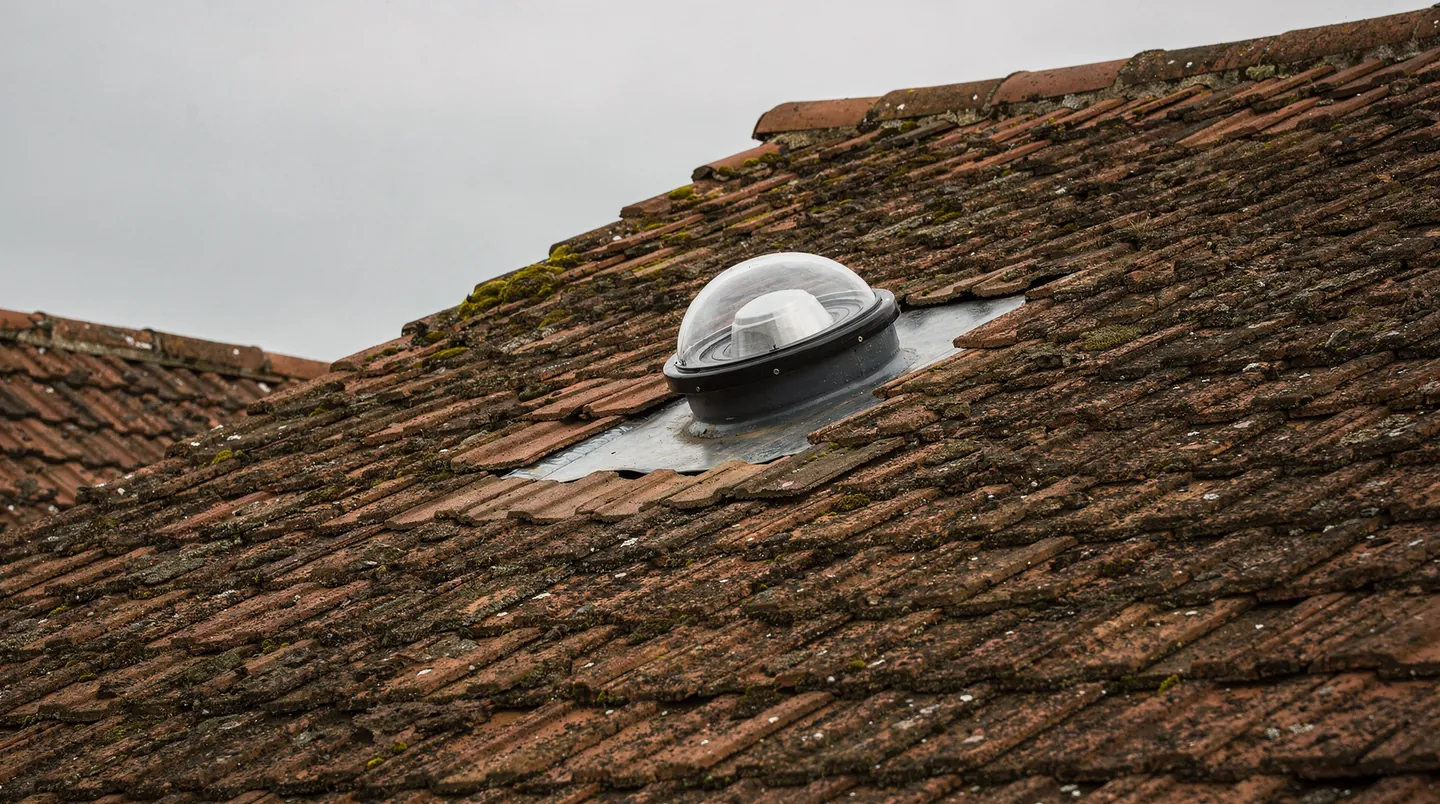
Plastic domes were a common way to light flat roofs and extensions for many years, and plenty are still in place. A typical one is a single or twin skin of acrylic or polycarbonate formed into a bubble, set on a plastic or timber upstand. They do their job in a plain way, but the material yellows under the sun, becomes brittle and can crack at the fixings, and the thermal performance is well short of a sealed glass unit.

Replacing one is usually more than a straight swap. A dome is often fitted to a kerb that was built for it, with a size and a profile that suits a bubble and not a flat-glazed unit. A flat rooflight sits on a square upstand, and the new kerb may need to be higher or better insulated than the old one. The membrane around it has to be dressed to the new shape.

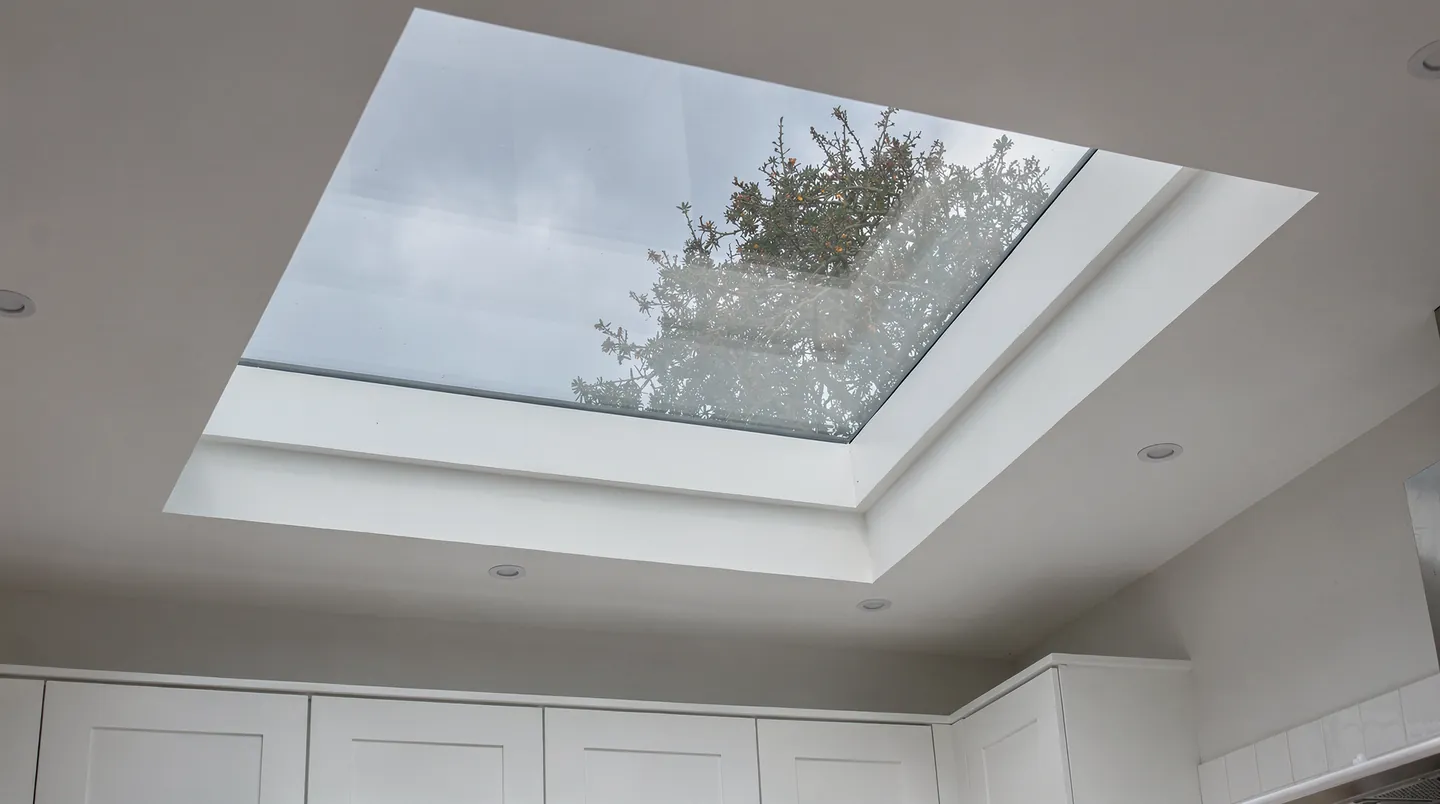
Blue sky and tree branches seen through a clear new rooflight above a kitchen
Clear sky and branches through new glass, where the old dome had turned yellow.

What the change brings

A current sealed glass unit passes more light with less colour cast, keeps heat in better and cleans more easily. You can choose double or triple glazing, a coating for solar control or self-cleaning, and a warm-edge spacer. If the dome is the only light source in a corridor or small room, the improvement is often noticeable at once.

Because a dome replaced by a flat or hipped unit is a whole new rooflight, the notification and energy limits apply. We look at the kerb, discuss whether it should be rebuilt, and put the kerb sizes in writing for your builder if carpentry is needed. If the new unit is to sit on the old kerb, we measure it on the roof and confirm whether it is sound enough to use.

Our guide to replacing an old polycarbonate dome goes into the choices of shape and glazing. A related question is whether a failed roof lantern can be given new glass and kept; the answer is in can a roof lantern be reglazed instead of replaced. Read both before deciding how far to go.

Part 05

Replacing during a re-roof

Doing it while the roofer is on site

If the flat roof around a failing rooflight is due to be re-covered, the rooflight should be part of that plan. A new membrane is laid up the kerb and tied into the frame, and if the rooflight is then replaced afterwards, that junction has to be disturbed and made good, often by a different firm. It is more sensible to renew the rooflight first and let the roofer dress the new covering to it.

The sequence is simple in outline. The old rooflight comes out and the kerb is checked, rebuilt or insulated as needed. The roofer lays the deck covering and takes it up the upstand. Then the new rooflight is lifted on and fixed, with the frame sealed to the finished kerb, and the roofer returns for any final dressing the manufacturer requires.

A rooflight and its roof are one junction, and it is better made once, by people who have agreed the order.

Agreeing the order of work

The difficulty is time. The roofer wants a clear programme, and a rooflight that arrives late leaves the opening exposed or covered over with a temporary board. We work back from the roofer's dates when we place the order, and the maker's delivery date goes to you and your builder together, so the rooflight and the membrane arrive in the right order.

We also agree the kerb with the roofer before work starts, including the height of the upstand above the finished surface and the way the membrane will finish at the top. That is the detail most likely to cause an argument on site if it is not discussed, and a short call beforehand removes it.

The page on replacing a rooflight when the flat roof is re-covered sets out who does what and when. If you are the one managing the roofing, working with your builder describes how we pass on sizes and dates, and builders are welcome to ring us directly.

Part 06

Ordering the replacement

Measuring the kerb and understanding the lead time

Replacement units are made to measure, so the order depends on accurate figures. We take them on the roof, because a rooflight installed years ago may not match any drawing and the opening may have moved a little with the building. A sealed unit is measured across the glass and the depth of the frame rebate. A whole rooflight is measured to the kerb, both outside and inside.

Measuring on the roof also lets us see what is under the old unit. The condition of the kerb, the position of any wiring, the type of roof covering and the access for lifting all feed into the quote. That is the reason a survey is part of the job and not an optional extra.

What we take at the measure
ItemWhy it matters
Glass size and unit depthA sealed unit is cut to the frame, and the rebate must take its thickness
Kerb outer and inner sizeA whole rooflight sits on these figures
Upstand heightIt has to stand clear of the finished roof surface
Frame conditionDecides glass only or whole unit
Roof covering and accessShapes the lift and the finishing detail
The sizes are written into the quote, so the order and the roof refer to the same numbers.

The lead time

How long the wait lasts is the maker's call, and it varies with the type of unit, its size and the glass chosen. Our quote carries the expected time, and the firm date follows when the order is in. Because sealed units are cut to size, the wait is often shorter than for a new frame, but the figure comes from the maker and not from us.

Plan for the gap. A misted rooflight usually does not need to be changed in a hurry, but if it is part of a larger job, the order should be placed early. For the usual stages and what affects them, see how long a rooflight takes to arrive. The question of how long the work itself takes on the day is answered in how long a rooflight replacement takes.

Ask your builder or roofer for the date they need the rooflight on site, or the date the opening must be closed, and give it to us when you accept the quote. A target date lets us say plainly whether the maker's lead time fits, and if it does not, there is still time to adjust the programme or to cover the opening temporarily. The worst case is a date discovered a week before the job, when nothing can be changed.

Part 07

Replacement day

Out with the old, onto the kerb, sealed and finished

On the day, the first job is to protect the room under the opening. We lay dust sheets and clear the floor, since the old unit will release dirt and debris when it is lifted out. For a large or heavy unit we agree the access beforehand, including where the lift will take place and whether scaffolding or a hoist is needed.

Two glaziers standing on a flat roof beside the kerb as a new sealed unit is lowered into place
Glaziers on the roof beside the kerb, setting a new sealed unit.

The old glass or frame comes out with care, and we inspect the kerb or the rebate that is revealed. Anything that has failed under the old unit is dealt with at this point, and if it affects the order or the cost, we tell you before going on. The seating is cleaned and checked for level, then the new unit is brought up and lowered in.

Fixing and finishing

A sealed unit is placed on its setting blocks and held in the frame with new beads and seals. A whole rooflight is fixed to the kerb with the maker's brackets, squared and checked for level, with the seal between frame and kerb closed. The roofer's flashings or membrane are dressed to the finished frame where that is part of the job.

Then we test it. An opening sash is cycled several times, the seals are checked, and the glass is cleaned inside and out. We remove the waste and the old unit from site, and we show you the finished rooflight. A job on a pitched roof or a flat roof is usually done within a day, subject to the size of the unit and the weather, and anything that will take longer is agreed in advance.

Afterwards, the plasterer or decorator can make good any marks on the reveal. If the old frame was stained or damaged, it may be worth timing the redecoration for just after the new unit goes in.

Part 08

Rooflights due for replacement in Southampton

Extensions from the 1980s to the 2000s and their original units

Southampton has a large stock of houses that were extended in the decades after the war, and many of those extensions have rooflights from the 1980s, 1990s or early 2000s. At that time double glazing in a roof was less common than it is now, and plastic domes and early sealed units went into kitchens, bathrooms and garden rooms all over the city. Those original units are now well past the point where a seal can be expected to hold.

Add to that the conservatory roofs and lean-to extensions that were built with glazed panels, often in aluminium or uPVC frames. Many have since been replaced with solid roofs and a lantern, but some remain, with panels that have clouded in rows. Replacing a whole run of sealed units at once is a common job, and it can be done pane by pane without taking the frame down.

How a survey leads to a replacement

  1. YouSend photographs or ask for a survey
  2. UsMeasure on the roof and judge the frame
  3. UsWrite the quote with the lead time named
  4. MakerBuilds the unit to the sizes
  5. UsFit it on the agreed day

What we look for in the city

In Southampton the combination of a sheltered inland position and exposure to the water means roofs weather in different ways. Frames near the coast can show corrosion earlier, and flat roofs under trees collect debris that holds moisture round the kerb. We check these on the roof, and where the frame has aged, the quote says as much and suggests a whole unit.

The aim is to give you a clear choice. Some owners prefer to renew the glass and keep a frame they know, while others use the opportunity to move to a better specification. We set out both options, with the lead time named for each, and the free survey costs nothing, so the decision can be made with the facts to hand.

If you are not sure what you have, send a photograph of the rooflight from inside and one of the roof, and we will say what we think. For guidance on cost across the services, see our costs page.

Where several rooflights in one house have clouded together, it makes sense to survey them all in one visit. The units were usually fitted at the same time, so they tend to age together, and ordering them as a batch means one measure, one delivery and one day on the roof. If one of them lights a stairwell or a bathroom with no other window, we plan that unit so the room is never left without cover overnight.

Where a replacement sits in the programme

Where a replacement sits in the programme
StageWeek 1Week 2Week 3Week 4Week 5Week 6Week 7Week 8
Survey and measure on the roofWeek 1
Scope agreed and quote acceptedWeeks 1 to 2
Unit orderedWeeks 2 to 3
Manufacturer lead timeWeeks 3 to 7
Kerb checked or rebuiltWeeks 5 to 6
Replacement dayWeek 7
Reveal decorationWeeks 7 to 8
  • Our work
  • Manufacturer lead time
  • Your builder and other trades
An illustration of a replacement where the kerb needs attention. A sealed unit alone can be quicker, and the real lead time comes from the maker.

Misted and failed rooflight questions

Can I just replace the glass in my rooflight?

Often yes, if the frame is sound, square and deep enough for a current sealed unit. We check this on the roof. Where the frame is worn or the kerb needs work, a new rooflight as a whole gives the better result, and the quote gives the reasons.

Is a replacement rooflight more efficient than the old one?

A new sealed unit carries a modern coating and gas fill and holds heat in better than an old or failed one. A whole new rooflight must also meet the current energy limit. We name the glazing in the quote so you can compare.

Does the room need to be empty on the day?

It helps to clear the floor and furniture under the opening, and we protect what remains with dust sheets. Tell us if there is a stairwell or fixed furniture below, so we can plan the lift and the access beforehand.

What if the kerb is damaged when the old unit comes out?

We inspect it as soon as the unit is lifted. If the kerb is unsound we tell you at once, explain what it needs and agree the next step before going on. Most kerbs are sound, but the check is part of the day.

Can an old plastic dome be replaced with a flat rooflight?

Yes, the usual route is a new flat or hipped unit on a kerb sized for it. The existing kerb may be reused if it is sound and suited to the new unit, or rebuilt if not. Because it is a whole new rooflight, the notification applies.

Will you need access from inside and outside?

Both, in most cases. We work from the roof to remove and fit the unit, and from inside to check the opening, protect the room and finish the reveal. We agree access with you when the date is set.

What happens if it rains on the day?

We watch the forecast and agree a day with a good outlook, and we carry covers for the opening. If the weather turns, we cover the opening and arrange a fresh day, because a roof should not be left open in the wet.

Book your free survey

We’ll visit, advise and provide clear written sizes for your builder.

Free survey. No obligation.

A dining room in a rear extension lit by a flat rooflight, garden doors open to the lawn
Call Get a free quote