The roofer's quote has arrived. It covers stripping the old felt, laying new insulation and putting down a fresh membrane across the whole flat roof, and halfway down the page there is a line about the rooflight: reinstate existing. The existing rooflight is the one with a clouded unit, a frame that has gone dull and a kerb nobody has looked at since the extension was built. The roofer is willing to lay the new covering around it, and it would be easy to say yes.
That line is worth a second look before it is signed, because a flat roof is at its most open to change exactly once every few decades, and this is that moment. The deck is bare, the kerb is visible, the covering has not yet been dressed to anything and every trade involved is already on the programme. Replacing the rooflight now means one set of scaffold, one set of dates and one finished upstand. Doing it later means cutting into a new roof to change a unit that sits at the heart of it. The sections below follow the job from the decision to the sign-off.
One job or two
The case for treating the rooflight and the roof as a single project comes down to what is easiest to change at each stage. While the old covering is off, the kerb can be raised, widened or rebuilt without disturbing anything finished. The membrane is laid in one operation, dressed up to the new unit, and tested by the weather as a single piece of work. After the roof is finished, any change to the rooflight means cutting back that membrane, and the new covering is already carrying its first winter.
There is a cost argument too, though we state no figures here. Access, scaffold, skips and the time the house spends with a stripped roof are shared between two jobs instead of paid for twice. A rooflight that was due for replacement within a few years of the re-cover is a clear candidate. So is any unit that has clouded, that sits on a low plinth, or that is a plastic dome. Our guide to replacing the glass or the whole unit helps decide how much of the rooflight needs to change.
Not every rooflight needs to go. A modern unit in good condition, on a sound kerb, can stay, and the roofer simply dresses the new covering to it. The survey is what tells you which situation you are in. We look at the frame, the glass, the kerb height and the condition of the base, and write down whether the existing unit can stay, can have new glass, or should be replaced entirely.
Sequencing with the roofer
On a combined job the order of work is set by what depends on what. The roofer strips the old covering and exposes the deck. The kerb is checked, altered or rebuilt. The new insulation and membrane go down, and the covering is taken up the kerb. Only then does the rooflight go on, after which the roofer or a second visit finishes the junction between the covering and the new frame.
| Stage | Who | What happens |
|---|---|---|
| Strip | Roofer | Old covering off; deck and kerb exposed |
| Kerb | Roofer or carpenter | Kerb raised or rebuilt to the supplied sizes |
| Covering | Roofer | Insulation and membrane laid; dressed up the kerb |
| Rooflight | Our fitters | Unit set on the kerb and fixed |
| Junction | Roofer | Covering finished against the new frame |
| Reveal | Plasterer, decorator | Inside lining and finish |
Because two firms are working on one roof, the practical points are about handovers. The roofer needs to know the finished kerb height and the unit's flashing detail before the covering is laid. We need the kerb to be finished and dry before the glass arrives. And someone needs to be named as the person who hands over each stage, since a roof with two sets of fitters and no one in charge is where small gaps open.
We usually fit the rooflight within a day or two of the covering being finished, so the opening is not left covered with a temporary board longer than needed. If the roofer is working to a tight schedule, we can set the glass the same day as the final dressing, and the roofer then closes the junction on the day the unit arrives. That is only possible when the unit has been ordered early enough, which is the subject of a later section.
Raising or rebuilding the kerb
The kerb is the upstand around the opening that carries the rooflight and the covering. When a flat roof is re-covered, the build-up of the roof usually changes: new insulation is laid on top of the deck, which raises the finished surface. If the kerb stays as it was, it now stands lower above the surface than it did, and the covering that is dressed up it has less height to work with.
Makers commonly ask for an upstand that stands 150mm or more above the finished covering, as their instructions set out. After a re-cover, an old kerb often falls short of that, because the roof has gone up and the kerb has not. It is usually built up with a timber or insulated upstand, or rebuilt entirely if it is unsound. The height for the new unit is worked out with the build-up of the new roof, so the kerb is measured against the finished surface, not the old one.
- Height: worked out from the finished covering, not the old deck.
- Plan size: matched to the new unit, which may differ from the old one.
- Material: timber, insulated upstand or GRP, depending on the roof.
- Insulation: carried up the kerb so the edge of the opening is not a cold path.
- Fall: the roof falls away from the kerb, so water does not pond against it.
The question of who builds the kerb comes up every time. Usually it is the roofer or the carpenter, because it is part of the roof structure, and we supply the sizes and the build-up for the unit being fitted before the work starts. Our page on who builds the rooflight kerb sets out the options. Whoever builds it, the sizes come from the unit that will sit on it, not the other way round.
Ordering ahead of the strip
The rooflight has the longest lead time of anything on a combined job, and it is the item most likely to hold up the roof if ordered late. A made-to-measure unit is built after the order, to the sizes of the finished kerb, and the time the maker needs governs when it can arrive. The roof, in contrast, can be stripped and covered in a few days. If the strip begins before the glass is on order, the roof may be covered and closed before the rooflight is ready, and the opening then sits boarded over.
So ordering happens early, counted back from the day the covering is due to be finished. The survey takes the measurements, the quote names the unit, its glazing and the build and delivery wait, and once you accept, the order goes in against the roofer's programme. The delivery date that the maker confirms is passed to you and to the roofer. If the date is later than the covering, we agree a plan: a temporary weathertight cover, or a slightly later start for the strip.
- Survey first. The existing unit, kerb and deck are checked before the roofer's quote is accepted.
- Sizes in writing. The kerb dimensions go to the roofer and builder for the chosen unit.
- Order next. The unit is ordered as soon as the sizes are agreed, before the strip is booked.
- Date confirmed. The maker's delivery date is passed to everyone involved.
- Strip booked last. The roofer's start date is set so the glass arrives as the covering finishes.
Strip dates should follow the glass date, not lead it. That sounds backwards to a homeowner who wants the roof done quickly, but a roof that is stripped and then waits for glass is the version that costs the most in weather exposure and in disruption. Our page on rooflight lead times explains what governs the maker's schedule, and how long a replacement takes covers the fitting itself.
Covering dressed to the new unit
The junction between the roof covering and the rooflight is where the two jobs meet, and the detail depends on the material. On a single-ply membrane such as EPDM, the sheet is taken up the face of the kerb and finished beneath the rooflight's trim or cill. On GRP, the laminate is carried up the upstand and finished to the line the unit needs. On built-up felt, upstand layers are bonded to the kerb and finished by the roofer to the maker's detail. Our page on rooflights on EPDM, GRP and felt roofs describes each in turn.
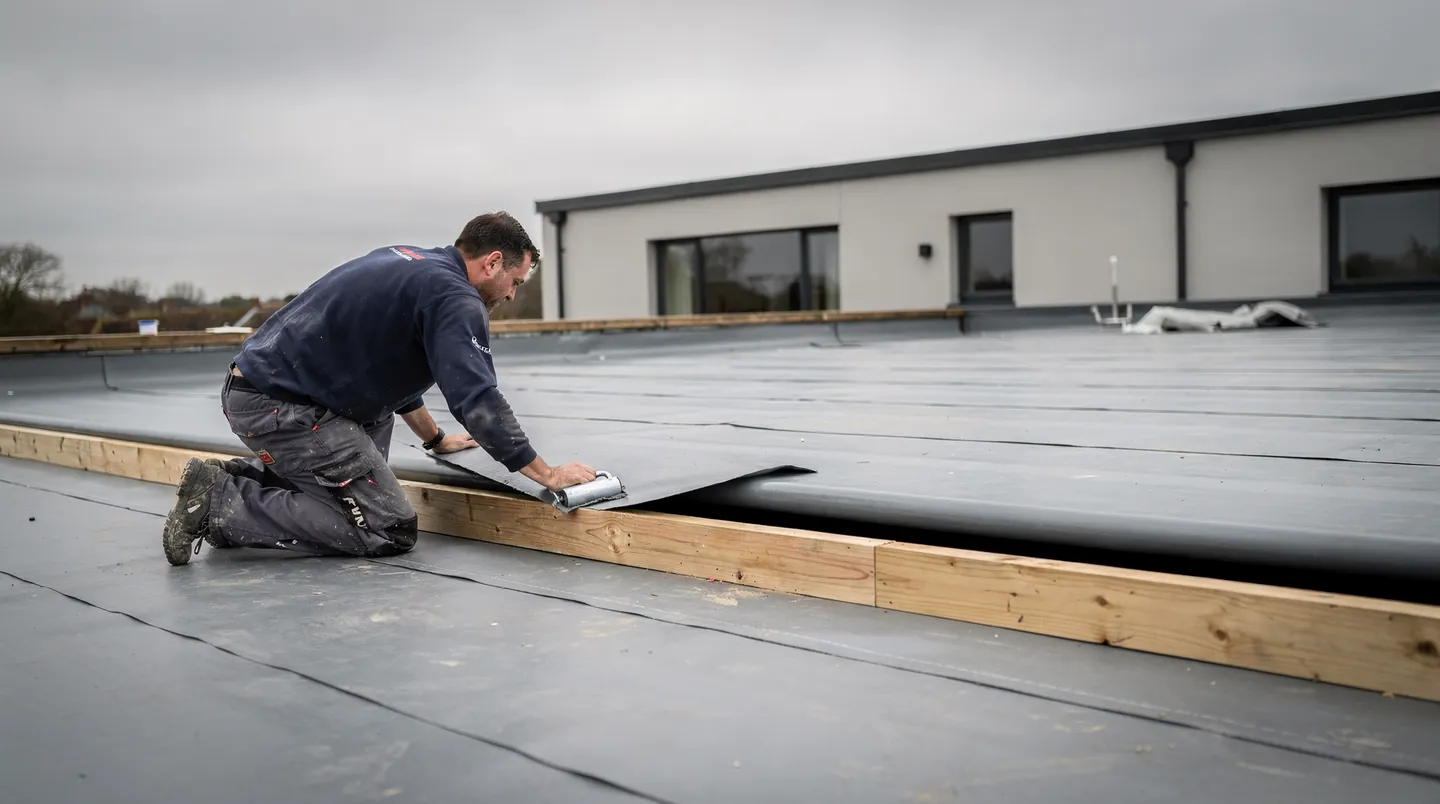
The order matters. The covering is dressed up the kerb first. The rooflight's frame then sits on or over that dressing, and its own trims close the top of the junction. A covering finished against the wrong frame, or against an old one that is then replaced, has to be cut and redone, and the new joint is never quite as good as one made once.
The covering and the rooflight each carry their own responsibilities. The roofer is responsible for the covering and its junction. We are responsible for the rooflight and the fitting of the frame to the kerb. Where the two meet, we agree in advance who completes what, so that the junction is made once, by one pair of hands, and there is no argument later about whose work a joint belongs to.
Sign-off for both
A combined job ends with two pieces of work that need to be checked together. The roof covering is looked at for laps, upstands, falls and finish. The rooflight is looked at for fit, seal and operation. The best time to check both is on the same visit, with the roofer and our fitters present, so that any small adjustment is made while everyone is there.
On the regulations side, a new frame and glass together make a controlled fitting, so a Building Control notification goes in. Approved Document L sets the energy limit for the replacement: 2.2 W/m²K for a rooflight, with a roof window judged as a window. The re-covering of a flat roof can bring its own energy requirements, which the roofer or the inspector will confirm for your roof. We deal with the notification for the rooflight, and we agree with the roofer who covers the roof side, so nothing is notified twice.
At handover you should receive the roofer's paperwork for the covering, ours for the rooflight, the glazing specification and the confirmation from Building Control where it applies. Keep them together. A later buyer's solicitor, or a builder planning the next phase, will ask for them. The 10-year workmanship guarantee covers the fitting of the rooflight, and the roofer's own cover applies to the roof.
Planning rarely arises when a rooflight is replaced like for like in the same opening, but a change in size, a listed building, a conservation area or a National Park setting can alter that. We research the position for the address and pass on the result, while the council holds the decision; the planning permission guide shows how to check it yourself.
To plan the two jobs together, start with a survey through the misted rooflight replacement service and send the roofer's quote along with it. The survey is free, and the written quote that follows is the document your roofer can build the programme around.
Questions from roofers and homeowners
- Can the roofer simply fit the new rooflight too?
- The roofer can build the kerb and dress the covering, and the rooflight is then fitted to the maker's instructions by our fitters. Keeping the two separate means each person works on what they know, and the junction is agreed beforehand.
- What if the glass is late and the roof is nearly finished?
- The roof is made weathertight around the opening with a temporary cover, and the unit goes in when it arrives. That is the reason we order early and ask for the roofer's start date to follow the glass date.
