A downstairs cloakroom has no window. The bathroom at the back of the landing has one, frosted and tiny. Upstairs, a bedroom under the eaves is bright enough in summer and gloomy from October. Each of these rooms could take a sun tunnel, a skylight or, in a few cases, either, and the choice usually comes down to what sits between the ceiling and the roof.
A skylight is a window in the roof. A sun tunnel is a small dome on the roof joined to a reflective tube that ends in a diffuser in the ceiling, and it carries light but gives no view. Neither is better in general. We survey the room, the roof and the loft above it, and recommend the one that suits the space, in writing, with the reasons. The sections below set out how to make that call yourself, and the same thinking is what we apply on a survey.
How each brings in light
A skylight, which covers roof windows, flat rooflights and lanterns, lets light in across its whole glazed area. The light enters at the angle of the sky, spreads across the ceiling and walls, and brings the sun's movement into the room. A large unit on a south-facing slope gives bright, changing light. A small one on a north slope gives soft, even daylight with little direct sun.
A sun tunnel collects light at the dome, passes it down a tube with a mirrored inner surface, and releases it through the diffuser. The tube is the limit. Every metre of its length and every bend takes a little of the light away, so a short, straight run delivers far more than a long, angled one. The result is a pool of even, shadowless light in the room below, at about the same level whatever the sun is doing, until the sky itself dims.
That difference explains most of the advice that follows. A skylight is a better source of light in terms of quantity, so for a room that needs lots of daylight, such as a kitchen, a loft bedroom or a studio, it is the stronger choice. A sun tunnel is a smaller source in a more flexible package, suited to rooms that are dark and need enough light to see by without turning on a bulb at midday. Our answer on how much light a sun tunnel gives goes into the comparison with a window in more detail.
| Point | Skylight | Sun tunnel |
|---|---|---|
| Source | Whole glazed pane | Small dome and a tube |
| Quality of light | Direct and changing, with sun on the floor | Even and diffuse from the ceiling |
| Effect of room size | Suits larger rooms | Suits small or narrow rooms |
| Dull days | Still gives a clear sky view | Gives a modest, steady glow |
Rooms with a loft above
The roof space decides the matter more often than people expect. A skylight in a pitched roof is easiest where the room already follows the slope, as in a loft conversion or a vaulted ceiling, because the window then sits straight above the room with no gap. Where a flat ceiling has a cold loft above it, a skylight needs a lined light shaft built through that space from the roof down to the ceiling, with insulation and plasterboard all round.
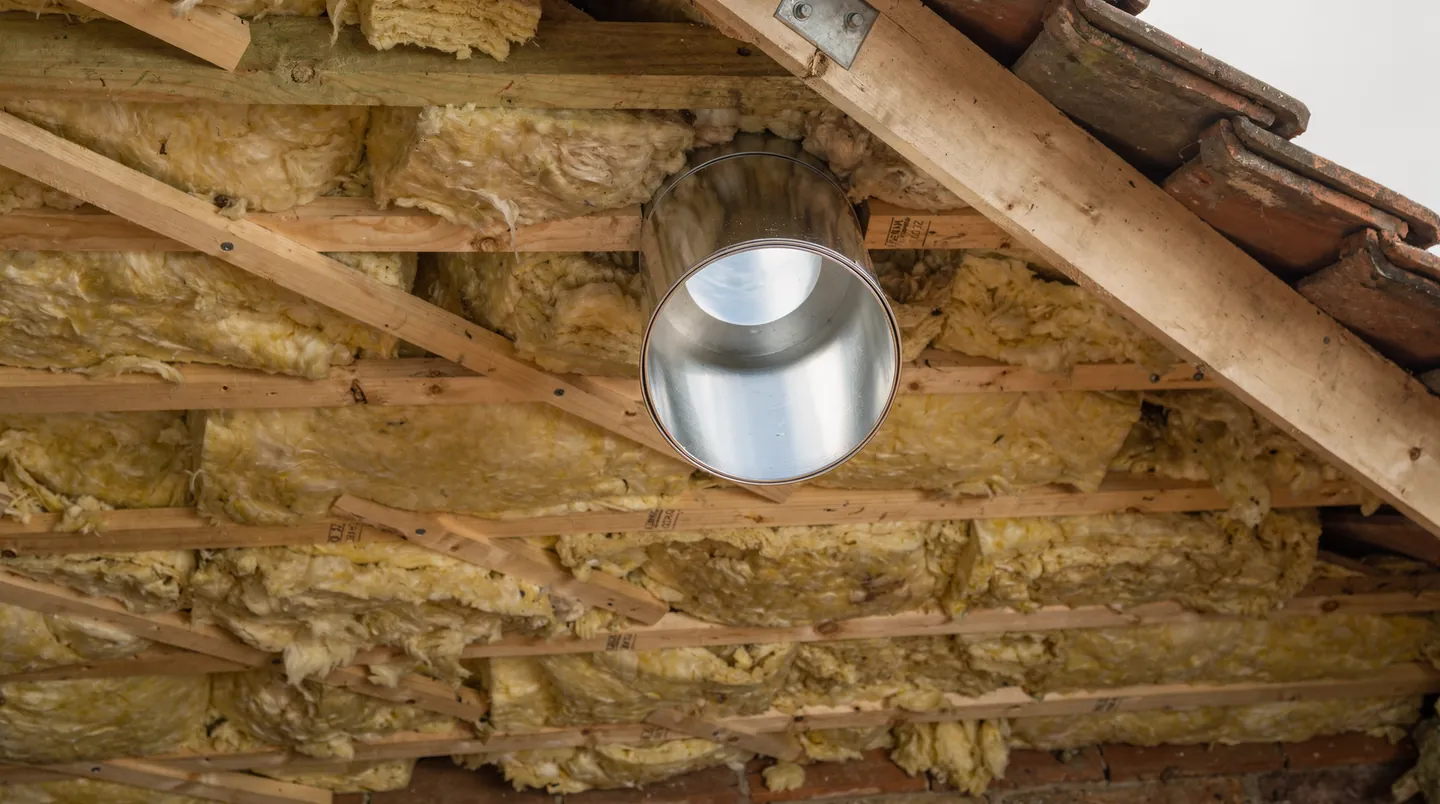
That is the situation a sun tunnel is designed for. The tube is the light shaft, and it is slim enough to pass between joists and rafters without trimming any of them. A landing, hall or bathroom with a loft above is the standard case: the room has no window, the ceiling is flat, and the roof is a few metres up. There is no need for a shaft the size of a window, and the tube can be angled to avoid water tanks, ducts and cables.
Where the space above the room is a habitable room, a skylight is rarely in question, because the roof is the ceiling. Where a roof is flat, the ceiling can often take either. A sun tunnel is also workable on a flat roof, as our answer on fitting one to a flat roof explains, while a flat rooflight is the alternative for a bigger opening, set out on the flat roof rooflights page.
View and ventilation
A skylight gives you the sky: clouds, birds, a tree top, stars at night. A sun tunnel gives you nothing to look at, because the diffuser is a frosted disc. For a bedroom or a study that matters, since being able to look up is part of the pleasure of a roof window. For a hall, a cloakroom or a stairwell, where nobody lingers, the view counts for little and the light is the reason to fit one.
Ventilation is the other half. Many skylights open, either by hand or by an electric motor, and an opening unit lets warm, moist air out of a kitchen, bathroom or loft room. It will not cure damp or condensation by itself, and extraction and heating still matter, but it gives a route for stale air that a fixed pane cannot. Our page on electric opening rooflights covers the range that opens by switch or remote.
A standard sun tunnel is sealed and does not open. Some makers offer add-ons such as a light fitting inside the diffuser or a small extraction attachment for use in bathrooms, so ask for the specification of the exact kit if you want one. Where a bathroom needs better air movement, the usual answer is an extractor fan alongside the sun tunnel, with the sun tunnel supplying the daylight.
- Need a view or fresh air: a skylight, an opening one for a kitchen or bathroom.
- Need daylight only: a sun tunnel does the job in a hall, landing or cloakroom.
- Both in one room: a skylight, plus an extractor where the room is damp.
Fitting and disruption
A sun tunnel is generally the quicker, lighter job. The installer cuts a hole in the roof just wide enough for the dome's base, fits the flashing, builds the tube down through the loft to the ceiling, then cuts the ceiling opening and fits the diffuser. No rafters need cutting, and no reveals need plastering. In the room below the work is confined to a circle in the ceiling, and a dust sheet and a vacuum are usually enough to clean up.
A skylight is a bigger job. A pitched roof needs rafters trimmed and framed to take the window, the covering cut back and the flashing fitted, then the sloping reveals around the opening lined and plastered inside. A flat roof needs a kerb built and waterproofed. The work is not unusual, but it involves more trades and more days than a sun tunnel, and it benefits from planning ahead.
That is where sequence matters. When the roof is already being built or re-covered, the best time to fit either is while it is open. Sending the opening size in writing to the builder or architect ahead of the structure lets the carpentry match the unit. The roofer then fits the membrane or covering first, and the electrician does first fix for any electric unit. Plastering of the reveals comes last. A sun tunnel fits into a finished roof with little fuss, but a skylight in a finished roof is cleaner when it is done as part of other work.
| Stage | Skylight | Sun tunnel |
|---|---|---|
| Roof opening | Rafters trimmed and framed | Small hole, no cutting of rafters |
| Roof space | Light shaft built if the ceiling is flat | Tube run through the loft |
| Inside the room | Reveals lined and plastered | Ceiling circle cut, diffuser fitted |
| Trades | Roofer, carpenter, electrician for electric units, plasterer | Roofer or installer, with a little making good |
Permission and regulations
On most houses a rooflight, whether a skylight or a sun tunnel's dome, is permitted development, meaning no planning application is needed. A sun tunnel has an advantage here because its dome stands only a little above the roof and is small. The exact rules, and the places where they stop applying, are set out in our guide to planning permission for rooflights, which we link rather than restate. Flats, listed buildings, conservation areas and National Parks are covered by different arrangements, and the council decides in each case.
Building Regulations apply to both. The opening in the roof must be properly framed and weathered, the tube or shaft must not become a cold bridge, and the work has to be insulated so that moist air from the room does not condense inside the tube. For a sun tunnel that means insulating the tube where it passes through a cold loft, which the installer should explain and which we include in the specification. Fitting is carried out to current Building Regulations, and the Building Control notification is handled where the work is notifiable.
Neither type is a Building Regulations requirement for daylight in an existing house in England; there is no daylight rule for houses, so you are choosing on comfort and not compliance. If the room is a loft conversion, though, other rules come in, including escape. An escape window is a window of a certain size that a person can climb out of, and it must be low enough to reach, so a skylight chosen for a loft bedroom needs to be picked with that in mind. A sun tunnel cannot serve as one.
Choosing for your room
Go room by room. A cloakroom, utility, landing or hall with a flat ceiling and a loft over it usually calls for a sun tunnel, particularly where a skylight would mean building a shaft. A loft bedroom, a kitchen extension or a studio usually calls for a skylight, because you want a view, opening, and a good quantity of light. Our guide to sun tunnels for hallways and landings works through the dark-hall case in depth.
A few rooms can take either, and the decision then rests on budget, disruption and how much the room needs the extra light. A sun tunnel is generally the simpler job, and a skylight the larger one, as our page on what rooflights cost shows. Whichever you prefer, ask for the unit, glazing and lead time to be named in a written quote. Delivery timing comes from the manufacturer and is confirmed after ordering.
A last point is the tube itself. If you pick a sun tunnel, the choice between a rigid tube and a flexible one affects how much light arrives and what the loft allows. Read the comparison of rigid and flexible tubes before you order, and take a look at the whole range on the sun tunnels page. For skylights, the roof windows page has the pitched roof options.
Smaller questions on the choice
- Can I fit a sun tunnel and a skylight in the same house?
- Yes, and many houses have both. A skylight lights a loft room or a kitchen extension, while a sun tunnel lights the hall, landing or a bathroom below the loft. They are separate openings with separate flashings.
- Does a sun tunnel work in a room with no loft above it?
- It works best where there is a loft to run the tube through. Where the ceiling is directly under the roof, a skylight is usually the neater answer, and a flat roof can take either.
- Which is quieter in heavy rain?
- Glass and the dome of a sun tunnel both carry the sound of rain to some extent. The glazing specification and the roof covering matter more than the type, so ask for the details of the exact unit in the quote.
