Put your head through the loft hatch above a dark landing and you see what a sun tunnel has to cross. Joists run in one direction, a water tank sits to one side, a cable snakes along a rafter, and the roof comes down at an angle that never lines up with the spot below. The tube has to get from the roof to the ceiling through all of that.
Two kinds of tube do that job. A rigid tube is made of straight, mirror-finished metal sections joined with adjustable elbows. A flexible tube is a ribbed, reflective tube that can be stretched, bent and pointed round obstacles. Each has a place. We choose between them on the survey, with the loft open in front of us, and set out the choice in the quote. The sections below explain what we weigh up.
How the tube carries light
Both kinds of tube work in the same way. Light enters at the dome, which is clear and often shaped to catch low sun, and then travels down the tube by reflecting from the inner surface, bouncing from wall to wall until it reaches the diffuser. The inner surface is the important part. The more of the light that is reflected at each bounce, the more arrives at the ceiling.
A smooth, polished mirror surface reflects light cleanly and loses very little with each bounce. A ribbed or corrugated surface scatters more, because each rib breaks the clean reflection and sends some of the light back up the tube. Every extra bounce, every bend and every extra metre of length takes a little more away. This is the physics behind the whole comparison, and it is why a short straight run of any tube beats a long twisting one.
The loss is gradual, not sudden. A room lit by a short run and a room lit by a long run both get daylight, and both are better than the artificial light they replace. The difference is in how bright the room feels on a dull afternoon. Our answer on how much light a sun tunnel gives covers what to expect from a given length, and the guide on choosing between a sun tunnel and a skylight puts that against a window.
Rigid tubes
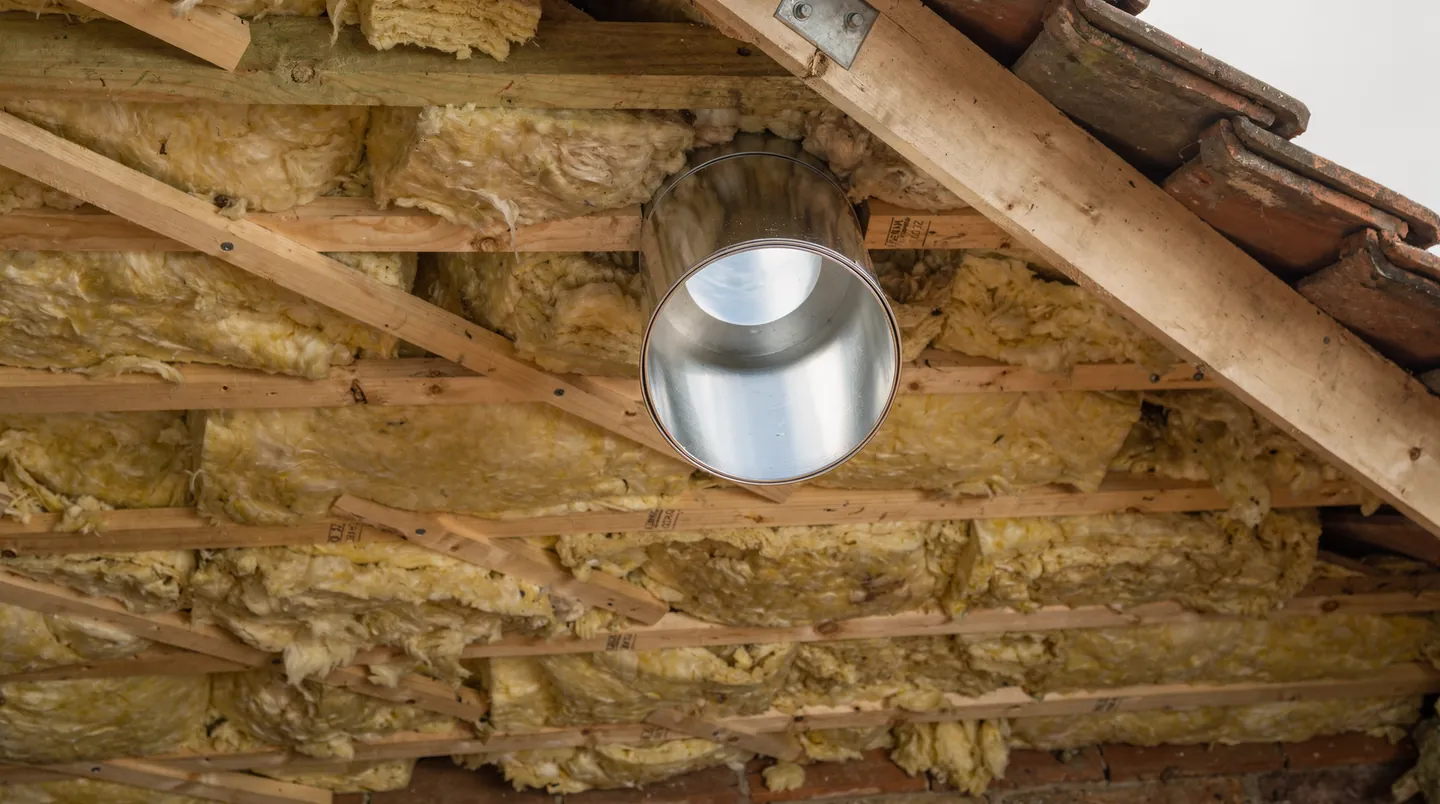
A rigid tube is built from straight lengths of metal with a highly reflective inner finish. The lengths are cut or telescoped to suit the distance between roof and ceiling, and joined to the dome base at the top and the ceiling collar at the bottom. Where the tube has to change direction, adjustable elbows turn it by a set angle. The whole assembly is a fixed shape, held in place and sealed at the joints.
The strength of a rigid tube is its light. A smooth, straight tube carries more daylight for its length than a ribbed one, so it is the first choice wherever the route is simple. It also keeps its shape. Nobody can crush or snag it in the loft, it does not sag between supports, and it presents a clean, neat appearance at the ceiling because the tube enters the collar squarely.
The limits are in the fitting. A rigid tube needs a clear, straight path, and the joints between sections need to be sealed and taped so that no light escapes and no warm moist air gets in. Elbows come in fixed ranges of angle, so a route with several turns can need several elbows, which each take a share of the light. A rigid tube also needs more working room in the loft, because the sections must be passed through and assembled in place.
- Best light over a given length, because the surface is smooth.
- Holds its shape in the loft and cannot sag or crush.
- Needs a clear route with enough room to assemble the sections.
- Elbows add loss, so each change of direction counts.
Flexible tubes
A flexible tube is a long, ribbed tube with a reflective lining. It arrives compact and is pulled out to length, then fixed to the dome base and the ceiling collar. Because it can curve, it follows a route that a rigid tube cannot: a gentle bend round a chimney breast, a sidestep to avoid a joist, an angle to meet a ceiling point that is offset from the dome.
That flexibility is what makes it useful in difficult lofts. A cramped roof space with a low pitch, a tank in the way or a ceiling position well to one side of the roof opening often needs a tube that can bend, and a flexible one can be fitted by one person working in a tight space. It is also lighter, simpler to carry through a loft hatch, and quicker to put in place.
The cost is light. The ribs scatter more than a smooth surface, so a flexible tube delivers less daylight over the same length. If it is left slack or is allowed to sag, the effect is worse, because kinks and folds trap the light. For that reason a flexible tube should be pulled taut, supported at intervals and kept as short and straight as the route allows. Left alone, it does a good job; left loose, it does not.
| Point | Rigid | Flexible |
|---|---|---|
| Light over the same run | Higher, smooth surface | Lower, ribbed surface |
| Awkward routes | Needs elbows and a clear path | Bends round obstacles |
| Working room in the loft | More, to assemble sections | Less, pulled to length |
| Risk of poor installation | Gaps at joints | Sag and kinks |
Length and bends
The length of the tube is set by the gap between the roof and the ceiling, and you cannot do much about it. A hall under a shallow pitched roof may need very little tube. A tall loft above a high ceiling may need much more. The reflective path gets longer as the loft gets deeper, and the light that arrives gets weaker. Makers publish guidance on the longest run each kit is intended for, and we work within it.
Bends matter as much as length. Think of the light as a ball bouncing down the tube: a straight tube lets it go down in a few bounces, and a bend sends it ricocheting against the wall. A shallow bend costs little, and a sharp one costs more. Two bends cost more than twice one, and a tube with a bend near the diffuser can leave the ceiling circle lit unevenly, with a brighter side facing the way the tube leans.
The rule we apply is to keep the route as short and as straight as the loft allows, and use a rigid tube for the straight part where possible. Where a bend is unavoidable, a rigid elbow set to a modest angle usually does better than a flexible tube forced round a tight curve. If a route needs both, a rigid run for most of the distance and a short flexible link at one end is a common solution. The quote says what has been specified and why.
Moving the dome often helps more than choosing a better tube. A sun tunnel can sit anywhere on the roof that has a view of the sky, so shifting it a little along the slope can turn a two-bend route into a one-bend route. For halls and landings in particular, our page on sun tunnels for hallways and landings describes how we pick the spot, working from the ceiling upwards.
Loft obstacles
The loft is usually the deciding factor, and the survey is done there. The usual obstacles are the joists, which set the width of the gap the tube must fit between; the roof timbers, which set where the dome can go; and the equipment that people store or run in the space: a water tank, pipework, an extractor duct, a bundle of cables, a chimney breast, a stack of boxes. Some are movable and some are not.
A rigid tube needs a straight corridor of clear space the width of the tube, plus room to turn elbows. If the tank is in the way, it must be moved, which is a plumber's job. A flexible tube can curve round a tank, a duct or a cable, which is often the whole reason for choosing it. If the path is cluttered with pipes and cables that cannot be moved, the flexible tube is the practical answer, as long as it can be kept taut and supported.
Insulation is part of the story too. The tube passes through the loft insulation, and the insulation has to be laid back around it properly, with the tube wrapped where the maker advises so warm air from the room does not condense on a cold surface. A flexible tube is easier to wrap neatly, while a rigid tube has joints to seal first. Either way the work is done to current Building Regulations, and the roof opening is framed and flashed to suit the covering.
Flat roofs have their own version of the problem. The depth between the roof and the ceiling can be small, which favours a short rigid tube, and the dome sits on a kerb or base as described in our answer on sun tunnels on flat roofs. If the ceiling is directly under a flat roof, there may be only a short drop and no real tube at all.
Choosing a tube
Put the choices side by side. Where the route from roof to ceiling is short and clear, a rigid tube is the better option, because it gives the most light and the neatest finish. Where the route is long, cluttered or offset, a flexible tube may be the only one that can get through, and a mix of the two is often best. The decision is made at the survey, not from a catalogue, because no one can see the loft from the street.
A few questions settle it. Is there a straight path from a good spot on the roof to the ceiling position? How many bends are needed? Is there room to assemble rigid sections, or is the loft too cramped? Can the equipment in the way be moved? Will the tube be supported along its length? Once these are answered, the tube follows. We write the answers into the quote, with the tube type, the dome, the diffuser and the number of elbows.
Price follows from the choice. A longer run, more elbows or a difficult loft all add work, and a simple short run is the lowest. Read the answer on what a sun tunnel costs for what drives the figure, and the costs page for the wider picture. When the sun tunnel is part of a bigger build, the roof opening is marked and sized in good time so the roofer and the builder can plan around it, andordering happens against the programme.
For everything else about the service, the sun tunnels hub collects the guides and answers in one place.
Tube questions answered briefly
- Can rigid and flexible tubes be combined in one sun tunnel?
- Yes. A rigid run for the straight part and a short flexible link where the route changes direction is a common arrangement, as long as the two are joined and sealed as the maker instructs.
- Does a sun tunnel with a flexible tube look different from the room?
- No. From the room you see only the diffuser in the ceiling, and both types use the same one. The difference is what happens in the loft.
- Who decides which tube goes in?
- It is settled at the survey, once the loft has been seen, and written into the quote so you and the builder know what is being fitted before the unit is ordered.
